Acute perturbations of whole-brain and triple-network connectivity during Low-Frequency-Right TMS for Treatment Resistant Depression
Jan 1, 2026·,,,,,,·
0 min read
Elizabeth Gregory
Ahmad Samara
Ruiyang Ge
Hallee Shearer
Afifa Humaira
Tamara Vanderwal
Fidel Vila-Rodriguez
Abstract
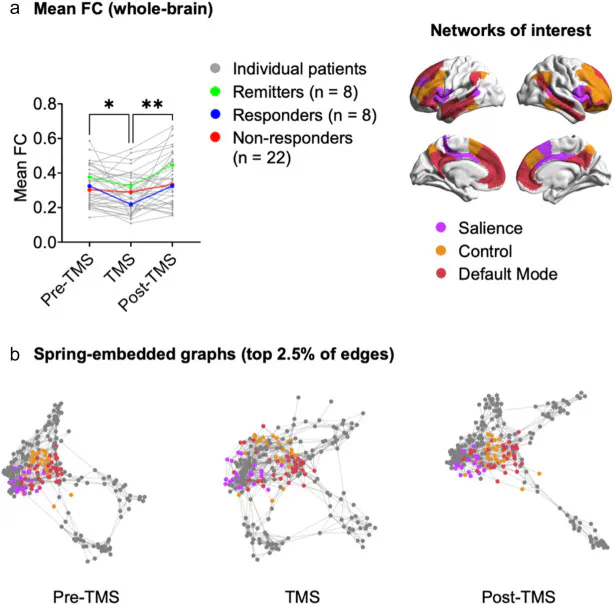
Concurrent transcranial magnetic stimulation and functional magnetic resonance imaging (TMS-fMRI) provides a mechanism for assessing the acute effects of transcranial magnetic stimulation (TMS) on functional connectivity (FC), allowing a unique perspective of how TMS induces antidepressant effects over the course of treatment. The aim of this secondary analysis of clinical trial data was to interrogate the relevance of the triple network theory in low-frequency TMS to the right dorsolateral prefrontal cortex (DLPFC) (low-frequency repetitive TMS [LFR]) by assessing perturbations in salience (SN), control (CN), and default mode (DMN) networks during TMS-fMRI.
Type
Publication
Neuromodulation: Technology at the Neural Interface